

Ask someone who went on safari fifteen years ago what they were hoping to see, and the answer was usually the same: lion, leopard, elephant, buffalo, rhino. The Big Five. The list that had been handed down from the hunting era, repurposed for the camera age, and turned into the organizing logic of an entire industry.
That framing still exists. But something has shifted underneath it, quietly at first, and now with enough momentum that the better safari operators are rebuilding their offerings around it. The travelers arriving in Africa today, particularly those investing seriously in the experience, are not primarily there to tick boxes. They want something harder to describe and considerably harder to manufacture: the feeling that they were actually present somewhere wild, not just passing through it.
Why Traditional Safari Tourism Often Feels Repetitive
The infrastructure of mass safari tourism was built for a different kind of traveler. Fixed departure dates, shared vehicles, three-country itineraries in eight days, lodges positioned near the highest-traffic wildlife corridors, all of it optimized for throughput and the reliable delivery of landmark sightings.
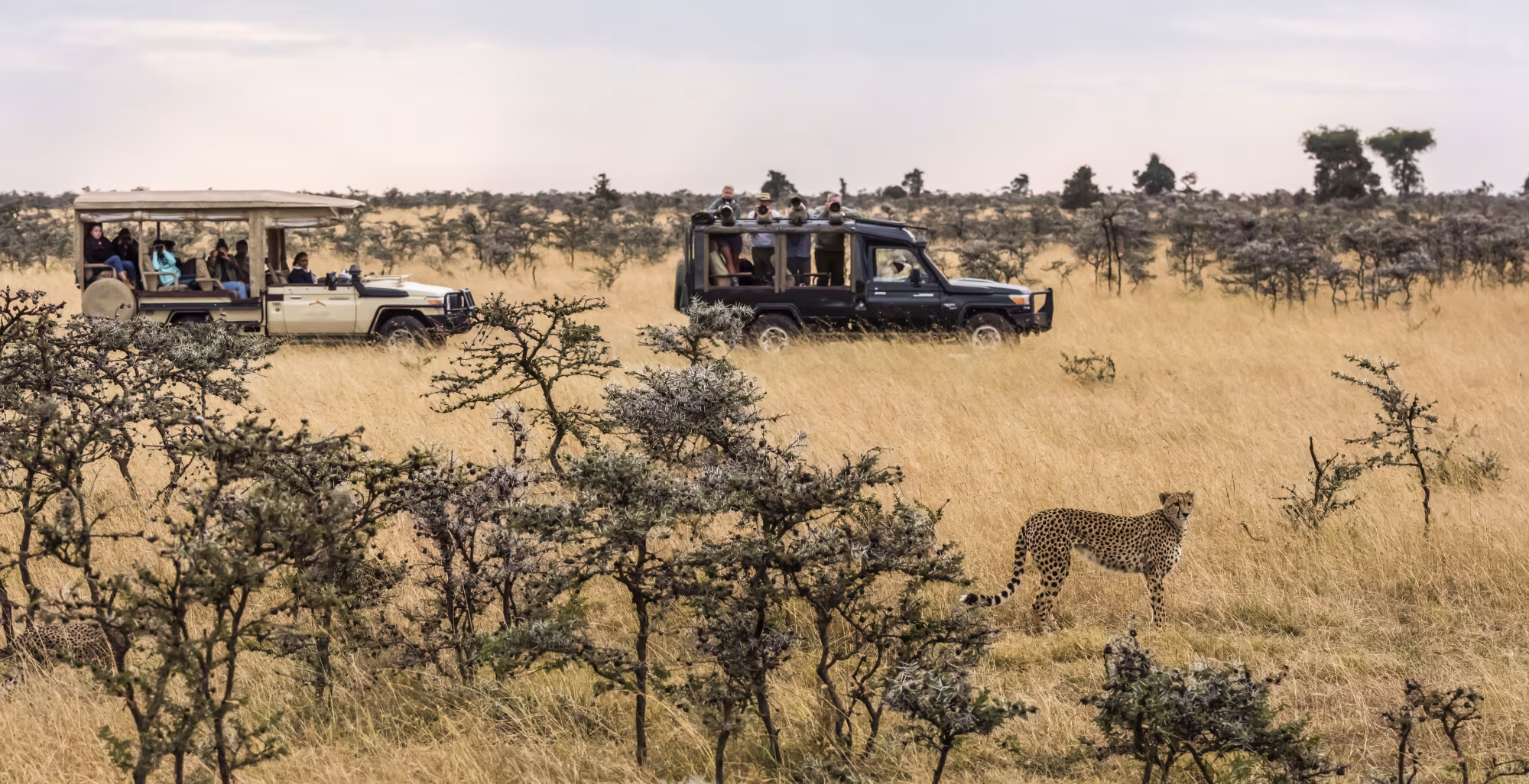
It works, in a narrow sense. Most people on a standard group safari will see lions. They will see elephants. They will photograph a leopard from fifty meters, surrounded by four other vehicles jostling for the same angle, while their guide monitors a radio network coordinating the arrival of twelve more. They will return home with images that are genuinely extraordinary by any objective measure, and a feeling they struggle to name. Not disappointment exactly, but a vague sense that the wildness they came for was somewhere just out of reach.
The problem is structural. When a wildlife sighting becomes a managed event, a coordinates-sharing network, a convoy of vehicles, a choreography of arrival and departure, it stops being an encounter with nature and starts being a performance of one. The animal is real. The landscape is real. But the experience has been optimized into something that resembles tourism more than it resembles wilderness.
Country-collection travel compounds this. The traveler who moves through four African nations in ten days, spending forty-eight hours in each ecosystem, accumulates geography without inhabiting any of it. They see more. They experience less. The Serengeti and the Okavango Delta and the Maasai Mara become, in retrospect, a single blurred impression of dust and savanna and animals that moved too quickly to understand.
Luxury accommodation does not fix this. Staying in an extraordinary lodge while following an ordinary itinerary produces an expensive version of the same hollow feeling.
The Rise of Experience-Driven Safari Travel
What has emerged in response is not a single trend but a cluster of related preferences, all pointing in the same direction. Travelers want private guiding, a naturalist who knows your interests before the first game drive and adjusts every morning accordingly. They want smaller camps inside private concessions where off-road driving is permitted and the vehicle-to-wildlife ratio drops from a convoy to a conversation. They want slower pacing, which means fewer locations and more time in each one, long enough for the ecosystem to begin to feel familiar, for the guide to learn what you’re drawn to, for the animals to behave as though you’re part of the landscape rather than an interruption to it.
Photography-focused travelers have driven some of this shift more visibly than any other group. The wildlife photographer doesn’t want fifteen minutes at a sighting before the vehicle moves on. They want three hours, repositioning slowly, waiting for the quality of light to change, watching a cheetah with cubs play out behaviors that only reveal themselves through time and patience. That kind of experience is impossible in a shared vehicle on a fixed schedule. It requires a guide willing to stay, a vehicle with no one else’s agenda in it, and a concession where the roads belong to you.
Conservation-focused tourism has added another layer. A growing number of travelers actively want to understand the ecological systems they’re visiting, not as passive observers, but as people curious about how a landscape functions, how anti-poaching operations work, how a private concession’s model connects the financial reality of tourism to the survival of the wildlife it protects. The best guides in Africa are extraordinary teachers, and the best safari experiences are built around giving them the time and space to do that work.
How Different African Destinations Create Completely Different Safari Experiences
One of the most important things to understand about safari travel, and one of the most systematically misrepresented in generic travel content, is that “Africa” is not a single destination. The ecosystems, the guiding cultures, the wildlife density and diversity, and the character of the experience vary so dramatically between countries that choosing the right destination for your specific goals matters enormously.
Botswana has built its tourism model around a philosophy of low volume and high value. Strict limits on visitor numbers, a ban on hunting, and the channeling of tourism revenue into conservation have produced a system where the wildlife encounters are extraordinarily intimate and the sense of genuine wilderness is almost unparalleled. The Okavango Delta, a vast inland river system that floods seasonally and creates one of the most biodiverse ecosystems on the continent, offers experiences that simply don’t exist anywhere else: mokoro (dugout canoe) trips through papyrus channels, walking safaris on islands between floodplains, camps so remote that the generator goes off at ten and the darkness is absolute.
Tanzania operates at a different scale entirely. The Serengeti is enormous, larger than some European countries, and the annual wildebeest migration that moves between it and the Maasai Mara in Kenya is one of the great natural spectacles on earth. The Ngorongoro Crater delivers something almost surreally concentrated: a collapsed caldera sheltering the densest wildlife population on the continent, enclosed within its own weather system. Tanzania rewards travelers who understand that its parks vary enormously in character and that timing, within an ecosystem this complex, changes everything.
Kenya brings something the purely wildlife-focused destinations don’t: the living presence of Maasai culture alongside the safari experience. The Maasai Mara itself has become congested during peak migration season, but the private conservancies surrounding it, community land leased from Maasai landowners, offer the intimate game-drive experience that the main reserve no longer reliably provides, while directing conservation revenue directly into local communities.
Zimbabwe is where the guiding culture reaches its highest expression. The walking safari was effectively invented here, in the Zambezi Valley, and the tradition of field guiding that grew from it has produced some of the most knowledgeable naturalists working anywhere in Africa. Mana Pools National Park, on the Zambezi River, is a genuinely remote and extraordinary place. Elephants stand on their hind legs to reach winter thorn pods, wild dogs den on the floodplains, and canoe trips past hippo pods on the river are a feature of the dry season. Zimbabwe demands a more adventurous traveler, but rewards them proportionally.
Uganda and Rwanda offer something categorically different from the savanna safari experience: gorilla trekking in montane rainforest. Spending an hour with a habituated mountain gorilla family in the Bwindi Impenetrable Forest or Volcanoes National Park is, by almost universal consensus among those who have done it, one of the most affecting wildlife experiences available anywhere on earth. It requires physical effort and the acceptance of genuinely wild conditions, and it produces memories of a specific and lasting intensity.
Namibia gives you scale and solitude in forms unavailable elsewhere. The Namib Desert, one of the oldest on earth, meets the Atlantic at Skeleton Coast in a landscape of almost hallucinatory strangeness. Desert-adapted elephants navigate ancient riverbeds in Damaraland. The private reserves bordering Etosha offer big-cat density alongside a vast salt pan that functions as its own kind of theater.
Why Safari Planning Now Matters More Than Ever
The proliferation of options has made this a genuinely complicated market to navigate. The difference between a transformative safari and a merely expensive one is almost invisible from the outside. Both come with beautiful photography, professional websites, and reassuring language about exclusivity and expertise. The gap only becomes apparent when you’re on the ground.
This is why the quality of planning, and specifically the quality of the specialist doing it, has never mattered more. Getting the destination right for your goals. Getting the timing right within that destination: the Okavango’s flood cycle, the Serengeti’s migration calendar, the window for reliable big-cat activity in the Maasai Mara’s private conservancies. Matching the character of a camp to the character of a traveler. Knowing which properties have maintained their standards and which have slipped, which guides are extraordinary and which are merely competent.
That kind of knowledge is not available on a booking platform. It comes from years of personal presence in specific places, from relationships with the people who run the camps and lead the walks and make the calls that determine whether a safari is good or genuinely remarkable.
Specialist operators like Only One Safaris are built around exactly this depth of knowledge. With more than 20 years of direct experience across ten African destinations, from Botswana and Zimbabwe to Mozambique’s remote island coast, their approach is to design tailor-made itineraries around the specific interests and travel history of each traveler, drawing on personal familiarity with every lodge and route they recommend. For anyone who understands that the planning is where the experience is either made or missed, working with people who have actually been to these places, repeatedly, over decades, is not a luxury. It is the whole point.
The Future of Safari Travel
The direction the industry is moving is not difficult to read. The destinations that have committed to low-volume, high-value tourism, Botswana most explicitly, but also the private concessions in Tanzania, Zimbabwe’s Zambezi Valley, Rwanda’s gorilla trekking sector, are setting the template for what responsible and genuinely compelling safari travel looks like in the long term.
The economics align with the conservation logic in ways that the mass-tourism model never quite managed. A camp hosting twelve guests who each paid significantly for the experience generates more conservation revenue, employs more local staff per visitor, and does less ecological damage than a camp hosting sixty guests who paid much less. The traveler gets a better experience. The ecosystem is less disrupted. The local community captures more of the economic benefit. It is a rare case in travel where the most rewarding option and the most sustainable one happen to be the same thing.
Eco-conscious tourism, once a niche preference articulated mostly in marketing copy, is becoming a genuine decision-making criterion for the travelers most invested in the quality of their experience. They want to know that the camp they’re staying in is a genuine partner in the conservation of the area it occupies, not just a business extracting value from a landscape, but an institution with a stake in its long-term health.
And beneath all of it, the most fundamental shift: the growing recognition that the best safari is not the one that delivers the most sightings. It is the one that changes how you see things afterward.
Conclusion
The travelers coming to Africa now, the ones who have thought carefully about what they want and are willing to invest in getting it right, are not primarily seeking animals. They are seeking an experience of time at a different pace, attention at a different depth, and silence of a quality that is increasingly rare in the developed world.
The best safaris deliver all of this. The leopard in the acacia tree is part of it, but so is the hour your guide spent explaining the relationship between a termite mound and the health of the surrounding soil, and the morning you stayed at a water hole long past the point when a checklist would have moved you on, watching something unfold that had no name and no Instagram caption and no way of being communicated to anyone who wasn’t there.
That is what safari travel, at its best, actually is. And it is what more and more travelers are crossing continents to find.
Frequently Asked Questions
Why are travelers choosing nature-based vacations?
A combination of digital fatigue, burnout from overcrowded tourist destinations, and growing psychological evidence linking nature immersion to wellbeing has shifted demand toward experiences that offer genuine disconnection. For many travelers, the appeal of wildlife travel is precisely that it demands full presence. The phone has no signal, the schedule belongs to nature rather than notifications, and the quality of attention required to watch wild animals resets something in the nervous system that ordinary life depletes.
Are safaris considered luxury travel?
Safari travel spans a wide range of price points, but the most sought-after experiences, private concessions, dedicated guides, smaller camps with limited guest numbers, sit firmly in the luxury tier. What has changed is the definition of luxury itself. The most discerning safari travelers are less interested in material opulence than in privacy, expertise, and depth of experience. A camp with eight tents and an extraordinary field guide is more desirable to this traveler than a resort with fifty rooms and a spectacular spa.
What makes wildlife travel unique compared to other travel experiences?
The unpredictability is a large part of it. No wildlife encounter is scripted or guaranteed, which means the best moments are genuinely earned rather than delivered on schedule. There is also the proximity question: watching a lion hunt, or sitting twenty meters from a gorilla family in a rainforest, produces a quality of attention and emotional response that most other travel experiences don’t approach. People come home from safari changed in specific ways that are difficult to manufacture through other means.
Why is slow travel becoming more popular in safari destinations?
Slow travel in safari terms means staying longer in fewer places, five nights in the Okavango rather than two nights in four different countries. The practical benefits are significant: animals habituate to vehicles they see repeatedly, producing more natural behavior and more candid encounters. Guides learn your interests and adjust each day’s focus accordingly. The ecosystem begins to feel familiar rather than alien. And the traveler has time to move beyond the thrill of novelty into something quieter and more lasting.
Are private safaris worth the cost difference?
For travelers who understand what the difference actually buys, yes. Private safaris offer access to private concessions where group safaris cannot go, a guide focused entirely on your interests rather than managing group dynamics, the freedom to stay at extraordinary sightings for as long as they last, and a pace determined by your curiosity rather than a shared schedule. The cost premium is real. So is the experiential gap.
What is experiential travel and how does it apply to safaris?
Experiential travel prioritizes emotional engagement and genuine immersion over landmark accumulation. Applied to safaris, it means choosing an itinerary built around your specific interests, wildlife photography, gorilla trekking, conservation learning, the migration, marine experiences in Mozambique, rather than a standard package designed to deliver the same highlights to everyone. The goal is not to see Africa but to understand a specific part of it, however briefly, from the inside.
Which African countries are best for private safari experiences?
Botswana is the benchmark for exclusivity and intimacy, built on a policy of low-volume high-value tourism. Zimbabwe offers the finest walking safari tradition in Africa. Zambia combines extraordinary wildlife density with a genuine frontier quality. Tanzania and Kenya are essential for the migration and big-cat concentrations. Rwanda and Uganda are unmatched for gorilla trekking. Namibia is extraordinary for desert landscapes and solitude. The right answer depends entirely on what a traveler is actually seeking.
Why are remote travel destinations becoming more popular?
Remoteness has become a form of value in its own right. The experience of being somewhere genuinely difficult to reach, a camp accessible only by light aircraft, a concession with no mobile signal, a rainforest that requires a day’s travel from the nearest city, offers something that convenience cannot: the sense of having arrived somewhere real. For travelers exhausted by the managed, the crowded, and the instantly accessible, remoteness is increasingly what luxury means.
